Monolith vs microservices: choosing the right SaaS architecture
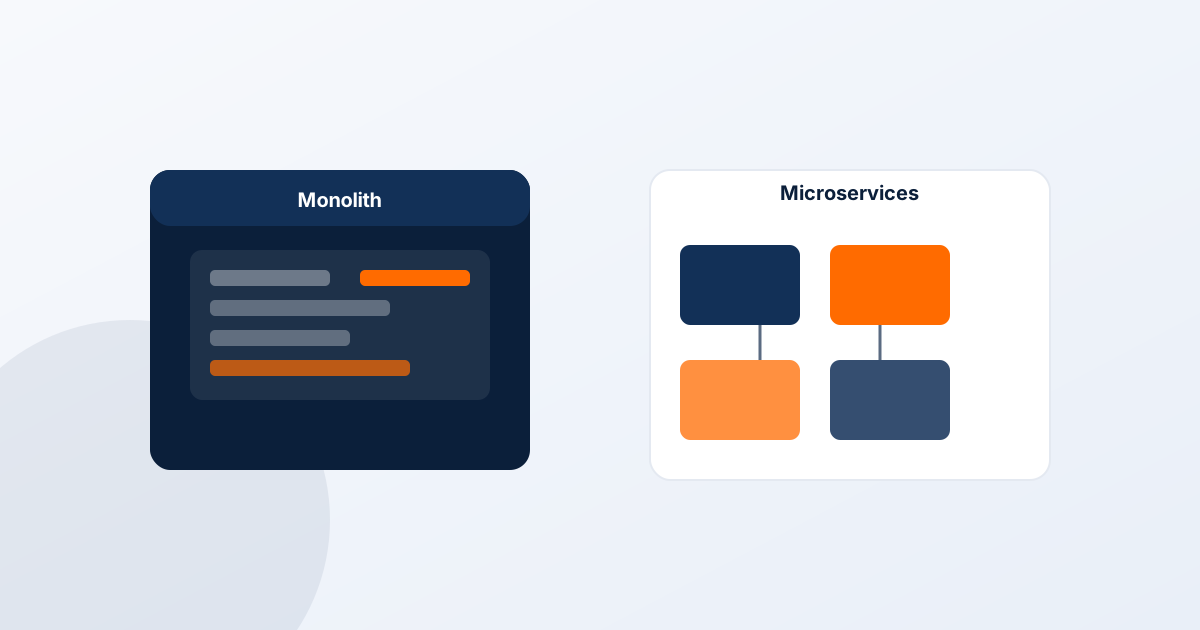
Microservices are the architecture equivalent of standing desks — useful, but not because everyone has one. The right answer for your SaaS depends on your team, your stage, and your release needs. Here's how we decide.
When the monolith is the right choice
A well-built modular monolith is the fastest path to revenue for most products. One codebase, one deploy, one database. It is dramatically cheaper to operate, easier to debug, and simpler for a small team to understand.
- Your team is under ~15 engineers
- Your product is still finding product-market fit
- Deploys happen a few times a day, not a few times an hour
- You value one-click rollbacks over per-service deploys
Most importantly, a monolith does not block scaling. Vertical scaling and read replicas carry a huge amount of traffic. Architecture is rarely what stops a SaaS from growing.
When microservices earn their complexity
Microservices exist to let independent teams deploy independently. That benefit only materializes when you have the teams to fill them.
- Multiple teams need to own and ship separate domains
- One workload genuinely needs different scaling than the rest
- You need isolated failure boundaries for a specific service
- You have mature DevOps, observability, and testing culture
The cost nobody mentions
Distributed systems add distributed taxes: service discovery, tracing, network latency, data consistency, and the operations burden of N pipelines and N dashboards. For a small team, this is not a choice about "the future" — it's about the next six months.
“We tell founders: build the monolith with disciplined module boundaries. If you outgrow it, splitting into services later is a known, boring process. Rewriting a premature microservice mesh into a monolith is the expensive, sad one.” — Neha Malhotra, CTO
A pragmatic middle path
Start with a modular monolith, deploy it with real CI/CD (or let CloudyDeploy run it), and keep clean APIs between modules. When one domain outgrows the shared deploy — not before — extract it.
We'll help you decide and build it
Architecture decisions are worth one focused conversation. Our custom software development team will map your product, team, and roadmap, then recommend — and build — the architecture that actually fits.
Related reading
CI/CD pipeline best practices
Deploy whatever you build, safely.
Product metrics that matter
Measure whether your architecture helps users.